Article
Year End Meta Ads Checkup: Do You Have Enough Creatives for 2026?
Tuesday, December 2, 2025

As 2025 wraps up, one thing is very clear about Meta Ads:
The platform has shifted from manual control to machine driven optimisation. Less time tweaking bids and interests. More weight on Meta’s AI systems, Advantage+ campaigns, and automated delivery.
If you run Meta Ads as an agency, an SMB, or an independent marketer, you probably felt that shift this year. What worked in 2022 or 2023 is not what is driving performance at the end of 2025.
The pattern that keeps showing up is simple:
Accounts that feed Meta more high quality creative usually win.
Accounts that starve it with a few stale ads fall behind.
The question going into 2026 is not “Am I targeting the right interest stack?”
It is “Do I have enough strong, varied creatives for Meta to find my winners?”
This post is your year end checkup and a practical look at how Eventsheet helps you actually run more winning ads without drowning in setup.
What 2025 taught us about Meta Ads
In 2025 Meta pushed even harder toward automation and AI:
Advantage+ campaign types became more common, especially for ecommerce and lead generation.
Creative combinations and asset variation became a core feature, not a nice to have.
Manual “hacky” targeting lost ground to broader audiences and optimisation based on outcomes.
Through all of that, one thing stayed consistent. Creative did the heavy lifting.
When you look back at the accounts that held or improved performance this year, they usually did a few things right:
They kept structure relatively simple, with fewer campaigns and ad sets.
They gave each ad set multiple distinct creatives to work with.
They refreshed creative before fatigue set in.
They let Meta gather enough conversion data before making big changes.
The accounts that struggled often had the opposite pattern:
Too many tiny campaigns and ad sets splitting budget.
One or two creatives that ran for months without updates.
Constant edits that kept ad sets stuck in the learning phase.
So as you plan for 2026, the lesson from 2025 is clear:
You do not need more complicated structures. You need more good creatives inside a structure that Meta can learn from.
Why “run more ads” is a strategy problem and an operations problem
On paper, “run more ads and let the algorithm pick the best one” sounds easy.
In reality, if you are an agency, SMB, or independent marketer, your day looks more like this:
A fitness franchise wants promotions for 40 locations.
An ecommerce brand wants creative tailored by collection and offer.
A SaaS client needs ads for trials, demos, and upgrades.
A local services client needs neighbourhood focused campaigns.
A creator wants to test 10 hooks for the same membership funnel.
You know you should be:
Testing multiple angles per offer.
Localising copy and creative for different locations or audiences.
Refreshing creative regularly.
But inside native Ads Manager that usually means:
Cloning campaigns or ad sets over and over.
Copy pasting city names, addresses, prices, and URLs.
Manually pairing images, videos, and copy for every variation.
Triple checking that the right creative points to the right landing page.
The result is predictable. You limit how many variations you launch because you simply do not have time to build them all.
The bottleneck is not strategy. It is operations.
That is the problem Eventsheet is designed to solve.
Eventsheet: the creative multiplier on top of Meta
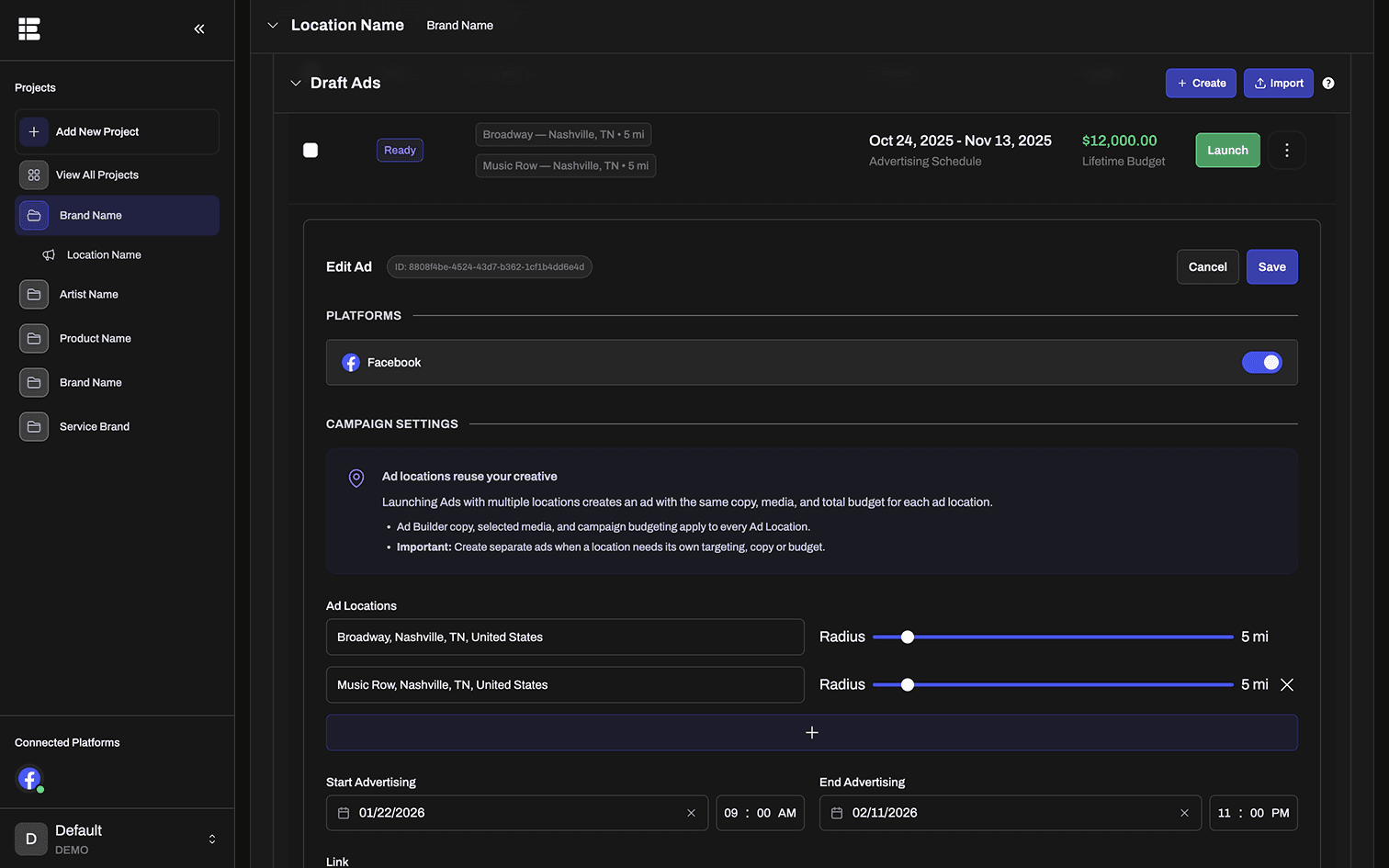
Eventsheet sits on top of Meta and turns structured data into campaigns at scale. It is built for agencies, small teams, and independent marketers who manage multiple brands and verticals.
Here is how it helps you go into 2026 with a creative strategy that matches how Meta actually works now.
1. Spaces and sheets that match how you work
Instead of bouncing between a pile of ad accounts and views in Ads Manager, Eventsheet gives you:
Spaces for each brand or client.
Sheets that represent campaigns and ad sets in an organised way.
You might have:
A space for your ecommerce skincare brand.
A space for a chain of gyms.
A space for a SaaS platform.
A space for a local services franchise.
Inside each space, sheets hold the data for the ads you want to run. You stay in one clear workflow instead of a maze of ad account screens.
2. Bulk ad creation from spreadsheets
Eventsheet is built around bulk creation from CSV or spreadsheet data.
You structure a sheet with columns like:
City, region, or location name.
Store, clinic, or gym name.
Offer details and promo dates.
Product or category names.
Landing page URLs.
Then you map those fields into your campaign and ad templates.
With that setup you can:
Generate fully built ads for dozens or hundreds of rows in one go.
Spin up tailored campaigns for many locations or product sets.
Launch at a scale that would be impossible by hand.
Instead of creating every ad manually, you design the template and let Eventsheet do the heavy lifting.
3. Dynamic variables for fast localisation
Eventsheet supports dynamic variables in your ad copy.
You can write templates like:
“Your {city} {niche} just got easier. Try {offer} at {location_name} this week.”
“New for {category} shoppers: {product_name} is now available online.”
Eventsheet replaces the variables with the correct values from each row.
That gives you:
Localised ads for every location.
Category or product specific messaging.
Consistent structure and tone across a lot of variants.
You get the creative volume Meta wants without manually rewriting each ad.
4. Multiple creatives that Meta can optimise against
Meta needs creative variety to find winners. Static creative for months is not an option in 2026.
Eventsheet makes it easy to attach multiple creatives to your campaigns:
Upload several images and videos per sheet or per row.
Let Eventsheet pair and structure those as distinct ad variations when it pushes to Meta.
You can mix:
UGC clips and product shots for ecommerce.
Facility shots, staff photos, and lifestyle content for fitness or local services.
Screen recordings, simple motion, and testimonial content for SaaS and apps.
Meta gets enough different looks and hooks to properly test. You keep your workflow manageable.
5. AI assisted copy that stays on brand
High volume creative only works if the copy stays on brand.
Eventsheet’s AI features help here:
Brand summary tools let you define voice, audience, and key messages once.
Copy assistance lets you generate multiple copy variations based on that brand summary.
This is useful when:
You are an agency writing for many brands.
You are a freelancer who needs to clone your thinking across multiple clients.
You are an SMB that needs more creative but has limited writing time.
You keep control of angles and offers while letting AI handle the heavy lift of rewriting and variation.
A practical 2026 Meta creative plan using Eventsheet
Here is a straightforward way to bring all of this together as you move from 2025 into 2026.
Review your 2025 performance by creative, not just by audience.
Identify which formats, hooks, and offers actually drove results. Use that to define a small set of “hero” angles for each client.Simplify your campaign structure.
For each objective, aim for a small number of campaigns and ad sets with enough budget to exit the learning phase. No more forests of micro campaigns that split signal.Build a sheet for each client or major initiative.
Add rows for locations, products, services, or offers. Include all the fields you will want in copy and reporting.Create flexible ad templates in Eventsheet that use variables.
Start with a handful of templates that can cover most of your 2026 use cases for that client.Use Eventsheet to bulk create ads and attach multiple creatives.
Let Eventsheet translate your sheets and templates into fully built ads inside Meta.Let Meta learn, then iterate.
Give your ad sets time and budget to gather data. Once you see which creatives rise to the top, use that feedback to update your sheets and spin the next wave.Schedule regular creative refreshes.
Make refreshing creative a recurring task, not a panic move after performance falls off. With Eventsheet, a refresh cycle is mostly new rows and assets, not a full rebuild.
Your year end checkup in one question
As you close out 2025 and plan for 2026, ask yourself:
If I look at my Meta accounts today, do they have enough strong, varied creatives for the algorithm to actually find the winners?
If the honest answer is “not really,” you are not alone. Most teams are under resourced on creative volume, not on targeting ideas.
Eventsheet gives you a practical way to fix that.
Instead of trying to out click the algorithm, you out create it - at a scale that your team can actually manage.
You set the strategy.
You define the offers and the ICP.
Eventsheet turns that into the creative volume Meta needs to make 2026 your best performance year yet.